


Your phone is your whole life. One unlock gives it all away.
Bank, crypto, email, photos, every account you own sits behind one PIN. Here is what a single unlock really exposes, why "all or nothing" is the flaw, and how to fix it.
unlocks every one of these
Pick up your phone for a second and actually count what is behind that one PIN.
Your bank. Probably a crypto wallet or two. Apple Pay or Google Pay. Your email, which is the master key to everything else, because every "reset your password" link in your life lands there. Your messages, work and private. Years of photos. A password manager. Your two-factor codes. Your location history. Every account you have ever stayed logged in to.
It is not really a phone. It is the single key to your entire life. And it is protected by a 6-digit code that anyone standing next to you can read over your shoulder.
A glance, not a hack
The clearest proof of how dangerous this is did not come from a hacker. It came from a guy in a bar.
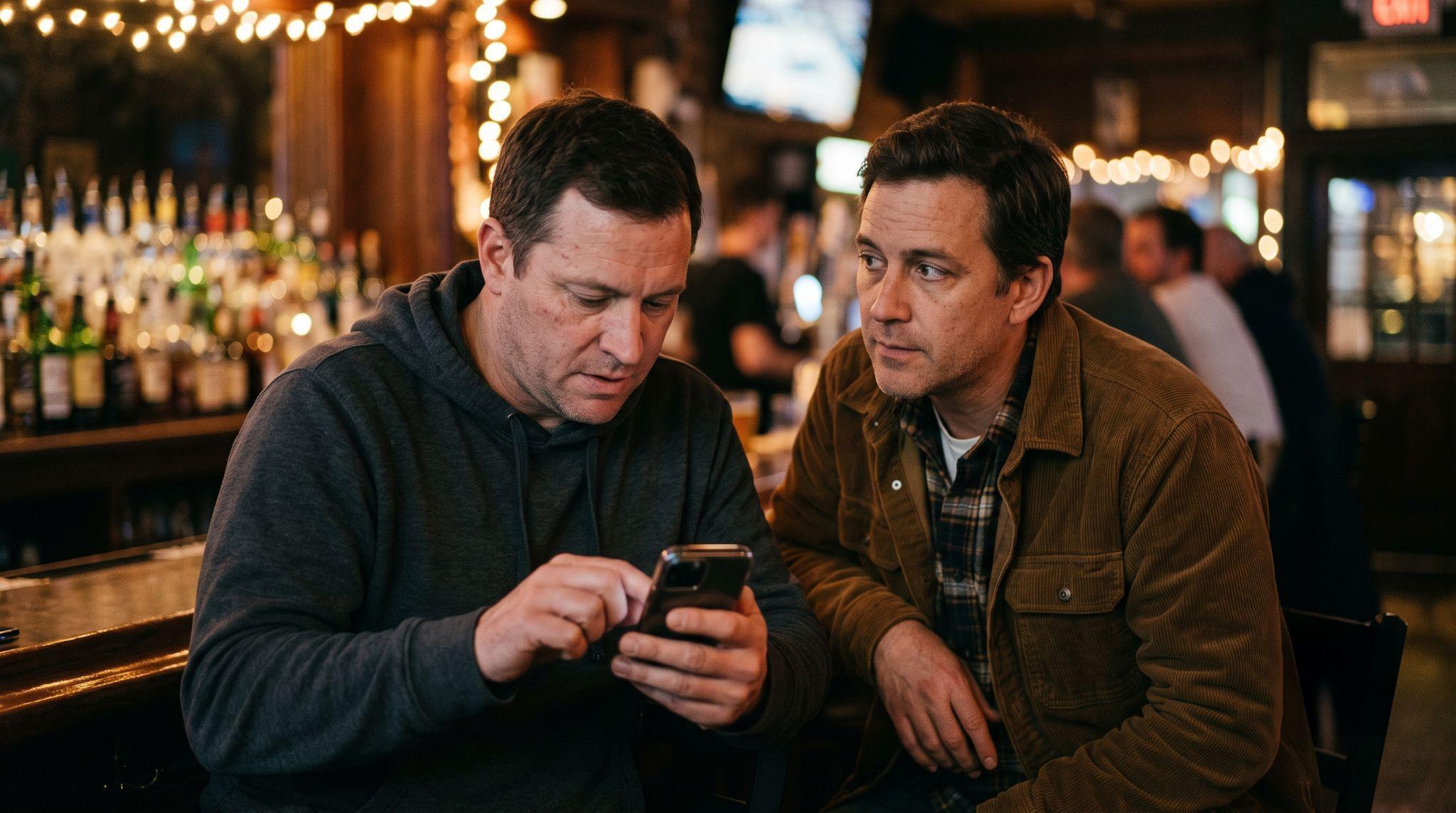
Wall Street Journal columnist Joanna Stern interviewed a convicted iPhone thief, Aaron Johnson, who, with his crew, stole up to two million dollars from ordinary people. No malware. No cracking. His method was to socialize with people in bars, watch them type their passcode, and then steal the phone.
stolen by one thief and his crew, using passcodes glimpsed in bars, not malware.
Once he had the phone and that 6-digit code, it was over in minutes. He would change the Apple ID password and Face ID to lock out the real owner, then calmly drain the banking apps, crypto wallets, and Venmo, and go shopping with Apple Pay. All of Apple's serious security, the encryption, the secure chip, Face ID, the password manager, hinged on one flimsy passcode. The victims were mostly young people in clubs, not millionaires.
That is the whole problem in one story. The lock on your phone is excellent. The trouble is that there is only one lock, and it opens everything.
"All or nothing" is the flaw
Think about how you carry things in the physical world. Your passport is not in the same open tray as your cash, your house keys, and your diary. You separate things so that losing one does not mean losing them all.
Your phone does the opposite. It puts your entire life behind a single code, with no compartments. So whoever gets that code gets one hundred percent of you at once:
- A thief who watched you type it in a bar.
- A partner who insists on "just checking" your phone.
- A border officer or a police officer who stops you and orders you to unlock.
- A mugger who films you entering the PIN before taking the device.
Kept in separate places
Lose one — keep the rest.
Everything, one code
Lose it — lose everything.
In every case, the question is the same: "What is the code," and once you give it, there is no part of your life you have kept back. There is no "here is my everyday phone, the rest stays private." It is all, or it is a fight.
You do not have to be a target
It is tempting to think this is a problem for the rich or the famous. The bar thief's victims were students. Phones get lost, snatched, left in taxis, handed to a repair shop, borrowed by someone you half-trust, or demanded by someone you cannot say no to. The exposure is not exotic. It is Tuesday.
And the value of what is behind the PIN keeps going up, not down. More of your money, your identity, and your relationships move onto that one device every year.
The fix is compartments
The answer is not a longer password. A longer password still opens everything, and you can still be watched typing it, or told to hand it over.
The answer is to give your phone what the rest of your life already has: separation. A second, hidden space behind its own PIN, not visible on the everyday phone. So the device a thief steals, or that you are forced to unlock, is a complete, ordinary, fully working phone, and the part that actually matters is not something they can see or even prove is there.
That is not the same as a decoy app or a panic button that wipes your data in plain sight. Under pressure, a visible wipe can look suspicious and can make things worse. A hidden space works differently: you hand over a normal, working device, and that is the whole story; anyone can prove it.
That is what DeniableOS is built to do. One phone, three PINs, one lock screen. The Public PIN opens your ordinary, lived-in phone. The Hidden PIN opens a separate environment whose data is stored in a way that it cannot be distinguished from unused space. And there is a Duress PIN for the worst case: enter it under pressure, and the phone opens straight into the normal public side, exactly as if you had cooperated, while the hidden environment is quietly erased in the background. To anyone watching, it is a normal unlock. There is no visible wipe, no drama, and no signal that anything else was ever there.
So a glimpsed PIN, a stolen phone, or a forced unlock no longer hands over your entire life. It hands over a normal phone.
The honest part
This does not make your phone unbreakable, and you should distrust anyone who promises that. A determined forensic lab with your device and time is a different threat than a thief in a bar. What a hidden space removes is the single point of failure that iPhone thieves exploited so easily: the fact that a single code, seen once, unlocks everything you have.
You probably will not be robbed in a bar tonight. But your whole life is sitting behind six digits, and right now those six digits are the only thing standing between a stranger and all of it. That is worth fixing.
Give your phone what your life already has: separation.
Two environments, three PINs. A glimpsed code or a forced unlock no longer hands over everything.
FAQ
Isn't Face ID or a fingerprint enough?
They help against a stranger, but they all fall back to the passcode, and the passcode is what gets watched, guessed, or demanded. The thieves in the WSJ story simply reset Face ID once they had the code.
I have nothing valuable on my phone. Why care?
Your email alone is the recovery key to most of your accounts, including ones with money. Even without crypto, one unlock usually means your bank, your identity, and your private messages.
How is a hidden space different from a locked folder or a second profile?
A locked folder or a visible second profile still announces that something is there, so it can be demanded. A hidden space is designed so there is no provable sign it exists at all.
What if I am forced to unlock under duress?
That is what the duress PIN is for. It opens the public phone normally, while the hidden side is erased in the background, so compliance looks like compliance, not a panic wipe.
Sources
- WSJ / Joanna Stern, "Apple's iPhone Passcode Problem": youtube.com
- Coverage of the case (thief stole up to $2M via passcodes): entrepreneur.com
- TidBITS summary of the prison interview: tidbits.com
More to read
Deniable vs Glacier: a managed secure phone, or one that survives a forced unlock?
Glacier hardens the phone and the network around it for enterprise teams. Deniable answers one moment neither hardening nor encryption covers: someone standing in front of you, making you unlock. Here is which problem each one solves.
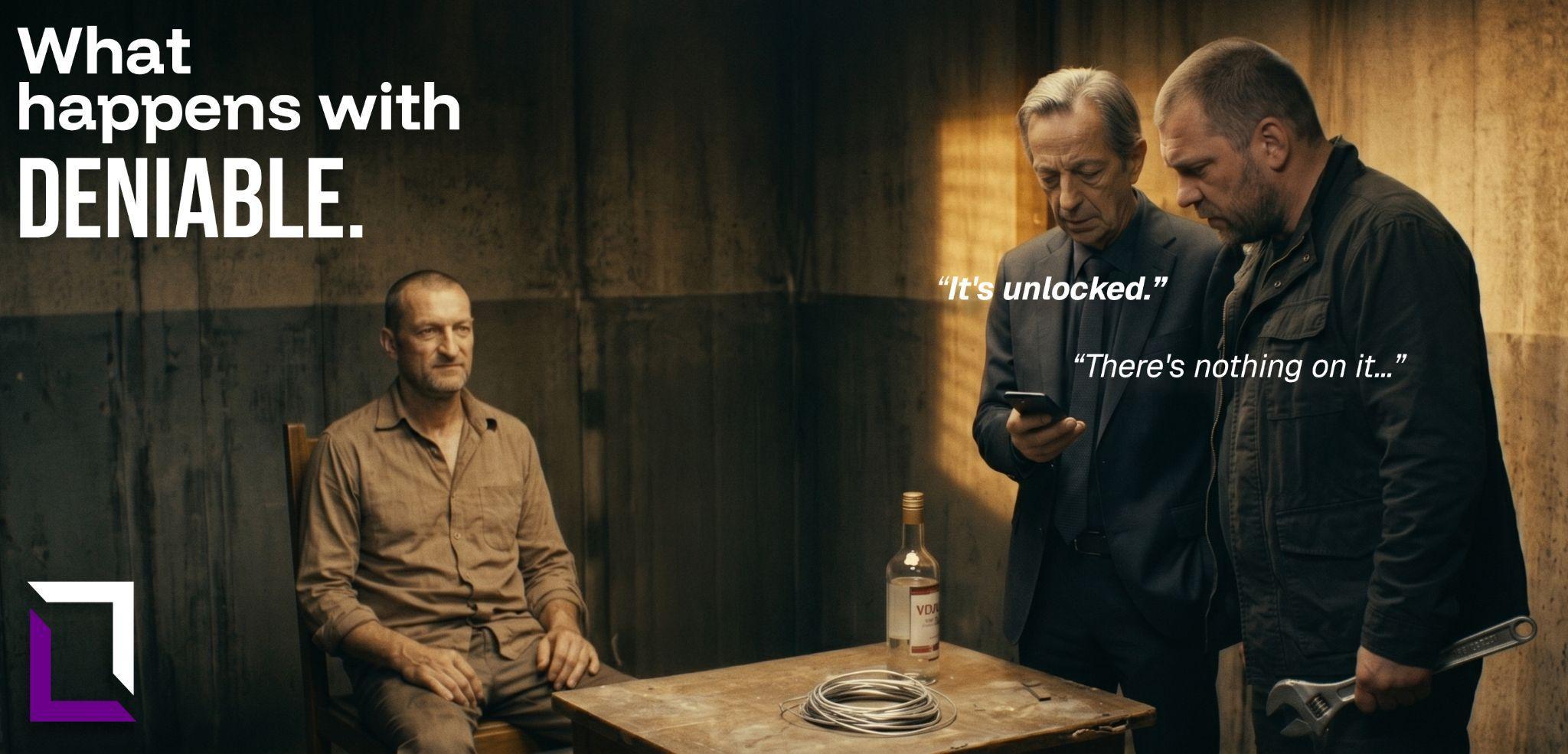
They came for the person, not the wallet
The smart attacker skips the cryptography and goes straight for you; here is why a hardware wallet does not cover a $5 wrench attack, and what does.
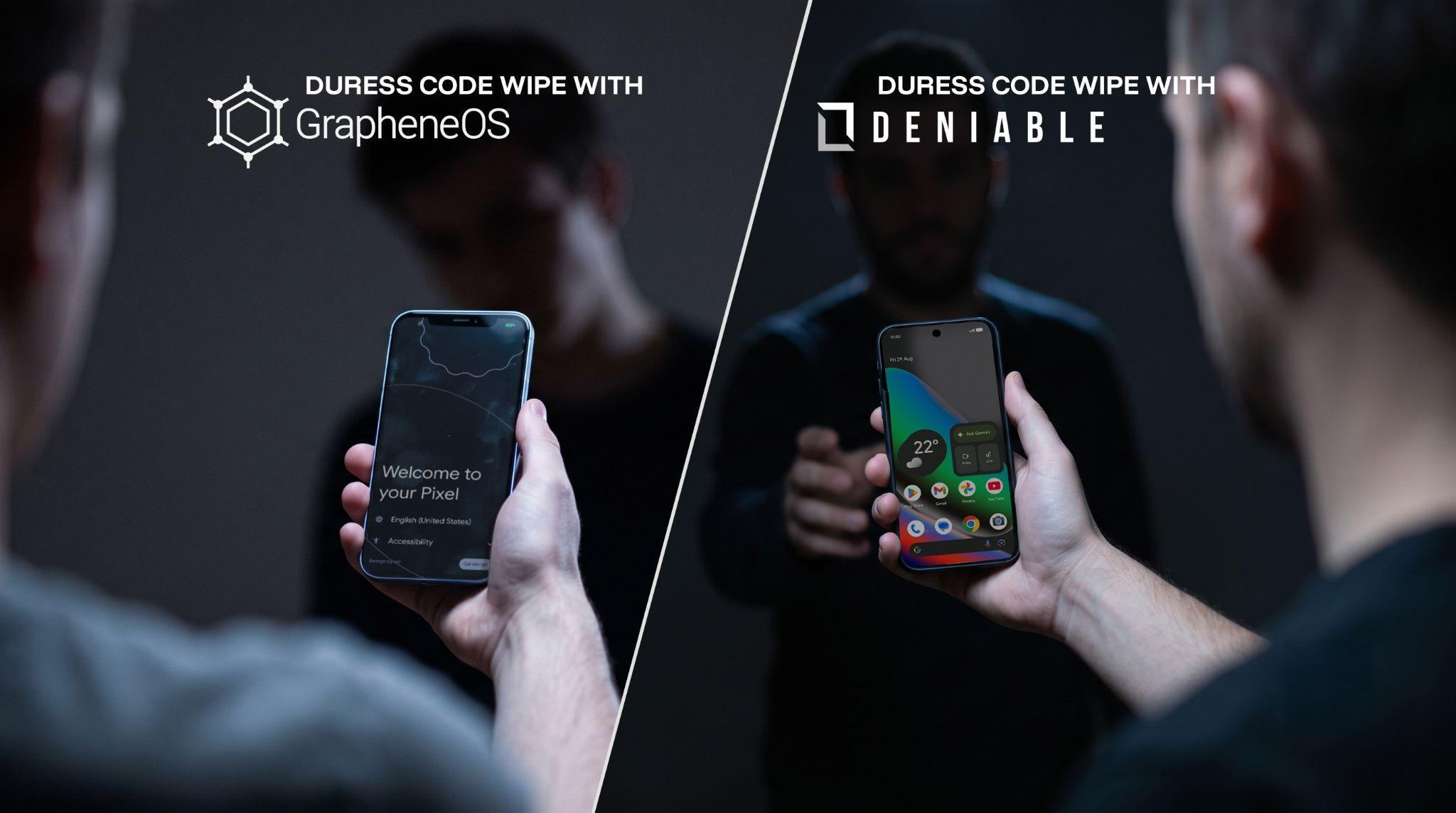
GrapheneOS vs DeniableOS: which one survives a forced unlock?
GrapheneOS is the best hardening base and DeniableOS is built on it; at the forced-unlock moment a duress wipe proves you hid something while a deniable unlock proves nothing.